Explore the explosive rise of online sports betting and equip yourself with proven strategies to identify, assess, and treat this rapidly expanding behavioral addiction.
The statistics are compelling: approximately one in three attorneys will likely require substance use or mental health support at some point in their careers.
But what about the “other” addiction—gambling?
In 2018, the United States Supreme Court, in Murphy v. NCAA, effectively opened the door to legalized sports gambling across the United States. By 2019, many states had approved both traditional and sports betting, making online gambling widely accessible via smartphones, computers, and tablets. When the world shifted in 2020 due to COVID-19 and the rise of remote legal practice, increased isolation combined with easy access to gambling created new risks—particularly for compulsive behaviour.
Today, internet gambling and sports betting apps are embedded in everyday entertainment. Whether these forms of gambling are ever truly “risk-free” depends largely on the individual and the nature of the risk involved. The links between compulsive gambling, financial misconduct, and self-harm are significant and well documented.
This program explores not only Gambling Disorder, but also its connection to more widely recognised forms of impairment. It examines why lawyers may be at heightened risk and highlights the often-overlooked consequences. The findings are both compelling and concerning.

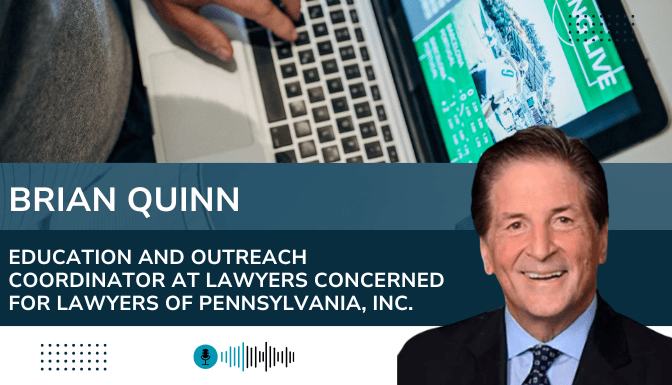
Education and Outreach Coordinator at Lawyers Concerned for Lawyers of Pennsylvania, Inc.
Brian S. Quinn, Esquire is a licensed attorney in Pennsylvania who currently serves as the Education and Outreach Coordinator for Lawyers Concerned for Lawyers of Pennsylvania, Inc., a Lawyers Assistance program established in 1988 for the purpose of helping lawyers, judges, and law students recover from alcoholism, drug addiction and mental health disorders. Mr. Quinn obtained his undergraduate degree in 1970, his law degree in 1973, and a certificate in Drug and Alcohol counseling in 2012, all from Villanova University. Prior to accepting his position with Lawyers Concerned for Lawyers in 2017, Mr. Quinn was engaged in private practice for nearly 40 years, handling a variety of civil and criminal matters. Mr. Quinn has also worked in the field of Alcohol and Drug Counselling at Mirmont Treatment Center and Malvern Institute in suburban Philadelphia. Mr. Quinn is a past member of the Board of Directors of Lawyers Concerned for Lawyers of Pennsylvania and served as a peer volunteer for over six years prior to accepting his current role as the organization's Educator. As LCL's Educator, Mr. Quinn has conducted CLE presentations for Bar Associations, private law firms, and professional organizations in Pennsylvania, as well as for National CLE providers, on a variety of topics in the fields of Lawyer wellness and impairment in the legal profession.
